

[Oct-2026] The Best AIChE CCPS Study Guide for the CCPSC Exam
CCPSC certification guide Q&A from Training Expert TestkingPDF
NEW QUESTION # 42
Asset Integrity inspection/test methods for tubes in shell and tube heat exchangers include (select all that apply):
- A. Dye injection
- B. Radiography
- C. Hydrostatic test
- D. Borescope
Answer: C,D
Explanation:
The correct answers are A (Borescope) and C (Hydrostatic test) because these are commonly accepted and practical methods for inspecting the condition and integrity of heat exchanger tubes under the Mechanical Integrity element of RBPS.
Borescope inspection (A) allows direct visual examination of the internal surfaces of tubes. It is particularly useful for identifying corrosion, fouling, pitting, cracking, and blockages . CCPS recognizes visual inspection tools as important non-destructive examination (NDE) techniques for assessing internal equipment condition.
Hydrostatic testing (C) is used to verify the pressure integrity and leak tightness of the exchanger tubes. By pressurizing the system with a liquid, operators can detect leaks or weaknesses that could lead to failure during operation.
Option B (Dye injection) is not a standard or recognized method for internal tube inspection in heat exchangers. While dye penetrant testing exists, it is typically used on surfaces-not for internal tube integrity in this context.
Option D (Radiography) is generally impractical for inspecting individual tubes in shell-and-tube exchangers due to geometry, access limitations, and effectiveness concerns.
CCPS emphasizes selecting appropriate, proven inspection techniques that effectively assess degradation mechanisms and ensure continued safe operation of critical equipment.
NEW QUESTION # 43
Which of the following statements apply to the purpose of an incident investigation? (Select all that apply)
- A. To prevent reoccurrence of the same or similar process safety incidents
- B. To document all injuries as process safety incidents
- C. To determine who should be disciplined for causing the event
- D. To help continually improve the process safety management efforts
Answer: A,D
Explanation:
The correct answers are A and C because CCPS defines the primary purpose of incident investigation as learning and prevention , not blame or administrative classification.
A (continuous improvement) is a core objective. CCPS emphasizes that incident investigations should identify system weaknesses, gaps in safeguards, and management system deficiencies. The findings are used to strengthen process safety programs, improve procedures, enhance training, and refine risk controls.
C (prevent recurrence) is the fundamental goal. Investigations focus on identifying root causes and contributing factors to ensure that similar incidents do not happen again. This includes both immediate causes and deeper organizational or systemic issues.
Option B is incorrect because CCPS promotes a no-blame or just culture approach . The focus is not on assigning fault or discipline but on understanding why defenses failed. Blame-oriented investigations discourage reporting and hinder learning.
Option D is also incorrect because not all injuries are classified as process safety incidents . CCPS distinguishes between occupational safety (e.g., slips, trips) and process safety events (loss of containment of hazardous materials). The purpose of investigation is not merely documentation but learning and prevention.
Overall, incident investigation is a critical feedback loop in RBPS for continuous risk reduction and organizational learning.
NEW QUESTION # 44
Discuss the training needs for personnel who may be required to respond to a release of a hazardous substance within a chemical facility.
- A. Provide only basic PPE training without practical exercises
- B. Provide comprehensive training including hazard recognition, emergency response actions, PPE use, and incident command understanding
- C. Focus only on theoretical knowledge of chemicals and hazards
- D. Limit training to evacuation procedures only
Answer: B
Explanation:
The correct answer is C because CCPS emphasizes that personnel expected to respond to hazardous substance releases must receive comprehensive, competency-based training that integrates knowledge, skills, and practical application. Under the RBPS elements of Emergency Management and Training and Performance Assurance , responders must be prepared to act safely and effectively under high-stress conditions.
Training should include hazard recognition , such as understanding chemical toxicity, flammability, reactivity, and potential exposure routes. Personnel must be proficient in emergency procedures , including alarm response, evacuation, shelter-in-place, and escalation protocols. A critical component is hands-on training in the use of personal protective equipment (PPE) , including selection, inspection, proper donning/doffing, and limitations of equipment like respirators and chemical suits.
Additionally, CCPS highlights the importance of understanding the Incident Command System (ICS) to ensure coordinated response, clear roles, and effective communication. Responders should also be trained in spill control, isolation techniques, and monitoring equipment usage to assess conditions safely.
Regular drills and simulations are essential to reinforce learning and build confidence. Importantly, training must also stress personal safety, situational awareness, and decision-making , including recognizing when to withdraw and allow specialized teams to intervene.
NEW QUESTION # 45
Which of the following can be considered applicable inspection methods as part of an Inspection/Testing
/Preventive Maintenance program under the Asset Integrity and Reliability Element? (Select all that apply)
- A. Ultrasonic Thickness Measurements
- B. Work Orders
- C. Ultrasonic Leak Detection
- D. Positive Material Identification
Answer: A,C,D
Explanation:
The correct answers are A (Ultrasonic Thickness Measurements), C (Ultrasonic Leak Detection), and D (Positive Material Identification) because these are recognized inspection and testing techniques within CCPS' s Asset Integrity and Reliability element of RBPS. This element ensures that critical equipment is designed, fabricated, installed, and maintained to perform reliably throughout its lifecycle.
Ultrasonic Thickness Measurement (UT) is a widely used non-destructive examination (NDE) method to monitor wall loss due to corrosion or erosion. It provides quantitative data that supports fitness-for-service evaluations and remaining life assessments.
Ultrasonic Leak Detection is another diagnostic tool used to identify leaks in pressurized systems, valves, and fittings. It supports early detection of loss of containment, which is critical for preventing process safety incidents.
Positive Material Identification (PMI) verifies that the correct alloy materials are installed, helping prevent failures due to incorrect material selection-especially important in environments prone to corrosion, high temperature, or hydrogen damage.
Work Orders (B) , while essential for maintenance management, are administrative controls rather than inspection or testing methods. CCPS distinguishes between execution systems (like work orders) and actual inspection techniques used to assess equipment condition.
These inspection methods collectively support proactive identification of degradation mechanisms and ensure equipment integrity is maintained.
NEW QUESTION # 46
Which of the following are effective methods for verifying that an operator understood the training provided?
(Select all that apply)
- A. Documentation from the trainer that the operator demonstrated understanding of the training provided
- B. An attendance sheet from the training course
- C. The operator signing a form to indicate that they understood the training provided
- D. A written quiz or test that must be passed after the training has been completed
Answer: A,D
Explanation:
The correct answers are B and D because CCPS emphasizes that training effectiveness must be verified through demonstrated understanding and competency , not simply attendance or acknowledgment.
Option B is correct because a written quiz or test is a structured method to assess whether the operator has understood key concepts, procedures, and safety requirements. Properly designed tests can validate knowledge retention and comprehension.
Option D is also correct because trainer verification of demonstrated understanding (such as practical demonstrations, simulations, or observed task performance) provides strong evidence that the operator can apply the training in real work situations. This aligns with CCPS expectations for performance-based competency assurance .
Option A is not sufficient because a signed form only confirms that training was completed, not that it was understood. Option C is also inadequate, as attendance does not demonstrate comprehension or ability to perform tasks safely.
CCPS stresses that organizations must ensure personnel are not just trained, but competent to perform safely , which requires verification through testing, observation, and demonstrated performance rather than passive confirmation methods.
NEW QUESTION # 47
Which is the main objective for investigating process safety incidents?
- A. Determine root causes and avoid recurrence
- B. Optimize inspection and maintenance
- C. Reduce the number of incidents and improve plant performance
- D. Improve the Control of Work system
Answer: A
Explanation:
The correct answer is C (Determine root causes and avoid recurrence) because CCPS defines the primary purpose of incident investigation as learning from events to prevent similar incidents in the future .
Incident investigations are not primarily about assigning blame or addressing immediate symptoms; instead, they focus on identifying underlying and systemic root causes , such as deficiencies in procedures, training, design, or management systems. By understanding why an incident occurred, organizations can implement corrective and preventive actions that reduce the likelihood of recurrence.
Option A and D may be outcomes of an investigation if specific deficiencies are identified, but they are not the main objective. Option B reflects a broader organizational goal, but it is achieved indirectly through effective investigations and corrective actions.
CCPS emphasizes that effective incident investigations should be thorough, objective, and focused on learning , often using structured methods such as root cause analysis. The findings should be communicated and tracked to completion to ensure improvements are implemented.
Ultimately, the goal is to break the chain of events leading to incidents , thereby enhancing process safety performance and preventing future harm.
NEW QUESTION # 48
Which of the following considerations should be addressed when developing a process safety Audit system?
(select all that apply)
- A. Scheduling audits
- B. Documenting audit results
- C. Performing audits
- D. Staffing of audit teams
Answer: A,B,C,D
Explanation:
The correct answer is A, B, C, and D because all listed items are essential components of an effective process safety audit system , as defined by CCPS within the RBPS framework.
Option A (documenting audit results) is critical because audit findings must be clearly recorded to ensure traceability, accountability, and follow-up of corrective actions . Without proper documentation, lessons learned may be lost and improvements may not be implemented.
Option B (scheduling audits) ensures that audits are conducted at appropriate intervals. CCPS emphasizes that audits should be planned, periodic, and risk-based , rather than ad hoc.
Option C (performing audits) refers to the actual execution of the audit process, including data collection, interviews, field verification, and evaluation of system effectiveness . This is the core activity of the audit system.
Option D (staffing of audit teams) is also essential because audits must be conducted by qualified, competent, and objective personnel . Proper team composition ensures technical expertise, independence, and credibility of findings.
CCPS highlights that a robust audit system includes planning, execution, documentation, and follow-up , all supported by competent personnel to ensure continuous improvement in process safety performance.
NEW QUESTION # 49
Austenitic stainless steels are typically susceptible to which of the following corrosion mechanisms specifically attributed to chloride exposure? (Select all that apply)
- A. Pitting corrosion
- B. Galvanic corrosion
- C. Uniform corrosion
- D. Stress corrosion cracking
Answer: A,D
NEW QUESTION # 50
Which of the following is generally a disadvantage of a rupture disc vs a relief valve?
- A. Reduced fugitive emissions - no simmering or leakage prior to bursting
- B. Less expensive way to achieve corrosion resistance
- C. Is relatively more susceptible to damage during installation
- D. Protect against rapid pressure rise caused by heat exchanger tube ruptures or internal deflagrations
Answer: C
Explanation:
The correct answer is C because rupture discs are generally more fragile and susceptible to damage during installation and handling compared to relief valves, which is a recognized disadvantage in CCPS guidance on pressure relief systems within Mechanical Integrity.
Rupture discs are thin membranes designed to burst at a specific pressure. Because of their delicate construction, improper installation (e.g., incorrect torque, misalignment, or physical handling damage) can alter their burst pressure or cause premature failure. This sensitivity requires strict installation procedures, trained personnel, and careful inspection practices.
Option A is actually an advantage of rupture discs. They provide tight sealing with zero leakage , preventing fugitive emissions and eliminating simmering that can occur in relief valves.
Option B is also an advantage. Rupture discs respond very rapidly to sudden pressure spikes , making them suitable for scenarios like deflagrations or tube ruptures.
Option D is generally considered an advantage as well, since rupture discs can be made from corrosion- resistant materials or coated, often at lower cost than equivalent corrosion-resistant relief valves.
CCPS emphasizes selecting pressure relief devices based on service conditions, reliability, response characteristics, and maintenance considerations, including installation sensitivity.
NEW QUESTION # 51
The Risk Based Process Safety element which is designed to verify that a process is verified safe to start after a short term shutdown is Operational Readiness. True or False?
- A. True
- B. False
Answer: B
Explanation:
The correct answer is B (False) because Operational Readiness in CCPS Risk-Based Process Safety is primarily intended for new startups, major modifications, or significant changes , not routine or short-term shutdowns.
Operational Readiness (often implemented as a Pre-Startup Safety Review - PSSR ) ensures that systems are properly designed, installed, tested, and safe to operate before initial startup or restart after major changes . It verifies that procedures, training, safeguards, and documentation are in place and that risks introduced by changes have been addressed.
For short-term or routine shutdowns , safety verification is typically managed through Operating Procedures and Safe Work Practices , such as startup checklists, shift handover processes, and standard operating procedures. These ensure that equipment is in the correct condition and that it is safe to resume operation without requiring a full Operational Readiness review.
CCPS distinguishes between routine operational control and formal readiness reviews for significant risk changes . Applying Operational Readiness to every short-term shutdown would be impractical and unnecessary.
Therefore, while verifying safe startup is essential, Operational Readiness is not specifically intended for short-term shutdown situations , making the statement false.
NEW QUESTION # 52
Which of the following are appropriate factors to consider when determining the number of individuals on the incident investigation team? (Select all that apply)
- A. The complexity of the incident
- B. The need for the investigation team to be well-balanced and unbiased
- C. The number of people that volunteer to participate
- D. The team should always include an external consultant or insurance agent
Answer: A,B
Explanation:
According to CCPS guidance on Incident Investigation and Learning , the size and composition of an investigation team must be determined based on the nature and complexity of the incident and the need to ensure an objective, competent, and balanced team . Option A is correct because more complex incidents- especially those involving multiple system failures, significant consequences, or unclear causal chains- require a larger team with diverse technical expertise (e.g., operations, engineering, safety).
Option D is also correct because CCPS emphasizes that investigation teams must be free from bias and include members with different perspectives to avoid premature conclusions or blame-focused outcomes. A balanced team improves the quality of root cause analysis and ensures credible findings.
Option B is incorrect because CCPS does not mandate the inclusion of external consultants or insurance agents in every investigation. While external experts may be useful in complex or specialized cases, they are not always required.
Option C is incorrect because team size should not depend on volunteers , but rather on required competencies and investigation scope. Allowing volunteers to determine team size can lead to inefficiency or lack of needed expertise.
Ultimately, CCPS stresses that investigation teams should be fit-for-purpose , technically capable, and structured to produce reliable, learning-focused outcomes.
NEW QUESTION # 53
A facility has several processes that need to be audited. There are 120 P & IDs (Piping and Instrumentation Diagrams) for the processes to be audited. The auditor responsible for Process Knowledge Management should:
- A. Request assistance from the lead auditor to distribute the load
- B. Review a representative sampling of P & IDs from all processes
- C. Only review P & IDs from the processes with the highest process safety risk
- D. Plan to extend the time required to do the audit
Answer: B
Explanation:
Comprehensive Explanation (CCPS-based):
The correct answer is D because CCPS auditing guidance emphasizes the use of representative sampling when the volume of information is large. Reviewing all 120 P & IDs is typically impractical and unnecessary for an audit, while reviewing only high-risk processes (Option A) could overlook systemic issues in lower- risk areas.
A representative sample ensures that the auditor evaluates consistency, completeness, and quality of process knowledge management across the entire facility , not just selected areas. This approach allows identification of systemic weaknesses , such as outdated drawings, missing information, or inconsistencies between documents and actual installations.
Option B may help logistically but does not address the audit methodology , which is the focus of the question. Option C is inefficient and not aligned with standard audit practices, which prioritize effectiveness and practicality .
CCPS promotes audits that are risk-informed, efficient, and evidence-based , using sampling techniques to draw valid conclusions about the overall health of a system without reviewing every single document.
NEW QUESTION # 54
The accumulation for a relief device is:
- A. The pressure increase over the MAWP expressed as a percentage of the set pressure
- B. The pressure increase over the set pressure expressed as a percentage of the set pressure
- C. The pressure increase over the set pressure expressed as a percentage of the MAWP
- D. The pressure increase over the MAWP expressed as a percentage of the MAWP
Answer: B
Explanation:
The correct answer is C because accumulation is defined (per CCPS and industry standards such as ASME) as the pressure increase above the relief device set pressure, expressed as a percentage of the set pressure .
When a relief device (such as a safety valve or rupture disc) activates, the system pressure is allowed to rise above the set pressure during discharge. This temporary pressure increase is called accumulation . It reflects the system's ability to safely handle overpressure while the relief device is relieving excess energy or material.
Mathematically, accumulation is calculated as:
Option A is incorrect because accumulation is not referenced to MAWP. Option B describes pressure relative to MAWP, which is not the definition of accumulation. Option D is also incorrect because it mixes MAWP and set pressure improperly.
CCPS emphasizes understanding accumulation as part of pressure relief system design , ensuring that vessels can tolerate the maximum allowable accumulation (often 10% for single relief devices under many codes) without exceeding safe limits.
NEW QUESTION # 55
Which of the following are Hazard Identification and Risk Analysis methods? (Select all that apply)
- A. Root Cause Analysis
- B. Layer of Protection Analysis
- C. Fish Bone Analysis
- D. Bow-Tie Analysis
- E. FMEA
- F. What-If
Answer: B,D,E,F
Explanation:
The correct answers are B (Layer of Protection Analysis), C (Bow-Tie Analysis), D (What-If), and F (FMEA) because these are recognized Hazard Identification and Risk Analysis (HIRA) methodologies within CCPS Risk-Based Process Safety.
What-If analysis is a qualitative method used to systematically evaluate deviations from intended operation by asking structured "what if" questions. FMEA (Failure Modes and Effects Analysis) is a structured technique that identifies potential failure modes, their causes, and consequences, often used during design and early lifecycle stages.
Layer of Protection Analysis (LOPA) is a semi-quantitative method that evaluates risk by analyzing initiating events and independent protection layers, determining whether risk reduction is sufficient. Bow-Tie analysis visually integrates fault trees (causes) and event trees (consequences), helping to identify preventive and mitigative barriers.
Root Cause Analysis (A) and Fishbone Analysis (E) are not HIRA methods; instead, they are incident investigation tools used after an event to determine underlying causes. CCPS clearly distinguishes between proactive hazard analysis (HIRA) and reactive learning methods (incident investigation and root cause analysis).
These HIRA tools are essential for identifying hazards, evaluating risks, and ensuring appropriate safeguards are in place to prevent major process safety incidents.
NEW QUESTION # 56
Which of the following statements apply to the purpose of an incident investigation procedure? Select all that apply.
- A. To promote uniform and accurate reporting and documentation of incidents
- B. To share the company's incident investigation practices with external stakeholders
- C. To provide guidance for the incident investigation team composition
- D. To define the training requirements for all incident investigation team members
- E. To promote thorough and timely incident investigations
Answer: A,C,D,E
Explanation:
The correct answers are A, C, D, and E because these reflect the core purposes of a structured incident investigation procedure as defined in CCPS Risk-Based Process Safety.
A (uniform and accurate reporting) is essential to ensure consistency in how incidents are documented, enabling effective analysis, trending, and organizational learning.
C (defining training requirements) ensures that investigation team members are competent in methodologies such as root cause analysis, interviewing techniques, and evidence collection. CCPS emphasizes that trained investigators are critical for high-quality investigations.
D (promoting thorough and timely investigations) is a key objective. Investigations must be conducted promptly to preserve evidence and ensure accurate findings, while also being sufficiently thorough to identify root and systemic causes.
E (guidance on team composition) ensures that investigations are conducted by a multidisciplinary team with appropriate expertise and independence, which improves the quality and credibility of results.
Option B is not a primary purpose of an internal investigation procedure. While sharing lessons learned may occur, the procedure itself is designed for internal consistency, rigor, and effectiveness , not external communication.
CCPS stresses that well-defined procedures are essential to ensure investigations consistently lead to actionable insights and prevention of future incidents.
NEW QUESTION # 57
During a Risk Based Process Safety audit, one operator states that refresher training should be provided more frequently. What actions should the auditor take? (Select all that apply)
- A. The auditor should interview additional operators before deciding whether to classify the observation as a finding
- B. The auditor should not classify this as a finding because the operator should not have been interviewed
- C. The auditor should classify this as a finding. No additional information is required
- D. The auditor should record this input, but not classify this as a finding based on a single observation
Answer: A,D
Explanation:
The correct answers are B and D because CCPS emphasizes that audit findings must be based on sufficient, corroborated evidence , not isolated observations.
Option B is correct because the auditor should capture and document all relevant input , including operator concerns. However, a single statement is not enough to justify a formal finding. It should be treated as potential evidence requiring further evaluation .
Option D is also correct because auditors are expected to seek additional information and validate observations . Interviewing more operators, reviewing training records, and examining performance data helps determine whether the concern represents a systemic issue or an isolated opinion .
Option A is incorrect because immediately classifying a finding without verification contradicts the CCPS principle of evidence-based auditing . Option C is incorrect because operator interviews are a critical part of audits , providing insight into how systems function in practice.
CCPS highlights that effective audits rely on triangulation of evidence -combining interviews, documentation, and observations-to ensure findings are accurate, objective, and meaningful for continuous improvement.
NEW QUESTION # 58
It is considered good Risk Based Process Safety practice to periodically review operating procedures, and this review must be done by the person who wrote the procedure.
True or False?
- A. True
- B. False
Answer: B
Explanation:
The correct answer is B (False) because, while CCPS strongly emphasizes the importance of periodic review of operating procedures , it does not require that the review be performed by the original author . In fact, CCPS Risk-Based Process Safety encourages independent, multidisciplinary review to improve effectiveness and identify gaps.
Operating procedures should be reviewed regularly to ensure they remain accurate, current, and aligned with actual plant conditions , especially after changes managed through MOC. However, limiting the review to the original author can introduce bias and reduce the likelihood of identifying errors or outdated information.
CCPS promotes involving operators, engineers, supervisors, and subject matter experts in the review process.
Operators, in particular, provide valuable practical insights into how procedures are used in real operations.
Independent reviewers are more likely to challenge assumptions and detect inconsistencies.
Additionally, procedure reviews should verify consistency with process safety information, training materials, and field practices . This supports safe and reliable operations and reduces the risk of human error.
Therefore, while periodic review is essential, requiring the original author to perform the review is not considered good RBPS practice , and broader participation is preferred.
NEW QUESTION # 59
An organization with strong Conduct of Operations is able to minimize: (select all that apply)
- A. The frequency of operator refresher training
- B. The frequency of process safety incidents
- C. The normalization of deviation
- D. Misunderstanding of expectations
- E. The frequency of process safety audits
Answer: B,C,D
Explanation:
The correct answers are A, C, and D because strong Conduct of Operations (CoO) ensures disciplined, consistent, and well-understood operational practices, which directly reduce errors and unsafe behaviors.
Option A (misunderstanding of expectations) is minimized because CoO emphasizes clear communication, defined roles, and standardized procedures , ensuring that operators understand exactly what is expected of them.
Option C (normalization of deviation) is also minimized. One of the key goals of CoO is to prevent gradual acceptance of unsafe practices. By enforcing strict adherence to procedures and promoting a questioning attitude, organizations avoid drifting away from safe operating limits.
Option D (frequency of process safety incidents) is reduced because consistent and disciplined operations lower the likelihood of human error, procedural violations, and unsafe conditions , all of which are major contributors to incidents.
Option B is incorrect because CoO does not aim to reduce training frequency; in fact, it may reinforce the need for ongoing training . Option E is also incorrect because audits are a management system requirement and are not reduced by CoO.
CCPS highlights that strong Conduct of Operations promotes operational discipline, reliability, and safety , directly improving process safety performance.
NEW QUESTION # 60 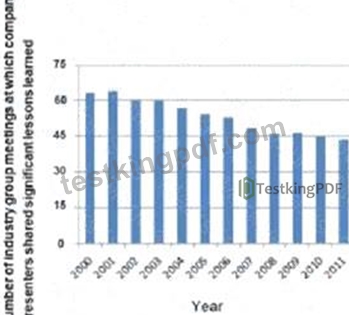
The X/Y/Z Corporation decides to track an activity as shown in the diagram. They interpret the results to indicate a possible deteriorating performance in one of their process safety management elements.
The chart shows a declining trend in the number of industry group meetings at which company presenters shared significant lessons learned over several years.
Which of the following RBPS elements is MOST directly reflected by this activity?
- A. Compliance with Standards
- B. Process Safety Competence
- C. Measurement and Metrics
- D. Stakeholder Outreach
- E. Workforce Involvement
Answer: D
Explanation:
The correct answer is C. Stakeholder Outreach because the activity being measured is the number of industry group meetings where company representatives share significant lessons learned . According to CCPS Risk- Based Process Safety (RBPS), Stakeholder Outreach focuses on communication and knowledge sharing with external parties such as industry peers, professional organizations, regulators, and the public. This includes contributing lessons learned, participating in industry forums, and promoting transparency to improve overall process safety performance beyond the organization.
The declining trend shown in the chart indicates that the company is reducing its engagement with external stakeholders , which may reflect weakening commitment to sharing knowledge and learning across the industry. CCPS emphasizes that proactive sharing of incident learnings helps prevent similar events across organizations and strengthens collective safety performance.
Other options are less appropriate: Measurement and Metrics refers to tracking performance internally but not the specific nature of the activity; Workforce Involvement relates to internal employee participation; Process Safety Competence concerns training and skills; and Compliance with Standards relates to adherence to regulations. The key distinguishing factor is external communication and collaboration , which directly aligns with Stakeholder Outreach.
NEW QUESTION # 61
All three flammable gas detection alarms have indicated in the control room the presence of a flammable vapor in the containment area below a horizontal butane storage tank. The correct operator response to this emergency would include (select all that apply):
- A. Deploy an operator with a combustible gas meter to determine the extent of the flammable cloud
- B. Remotely isolate the inlet and outlet lines of the butane tank, if this capability exists
- C. Remotely activate the tank area deluge system, if one exists
- D. Notify management of the situation
- E. Notify workers to leave the butane tank area
Answer: B,C,D,E
Explanation:
The correct answers are A, B, D, and E because they reflect safe and appropriate emergency response actions aligned with CCPS guidance for handling flammable vapor releases.
Option A is critical because personnel must be evacuated immediately from areas where flammable gas is detected to prevent injury or fatality in case of ignition.
Option B is correct because isolating the source of the release (if it can be done remotely) helps stop or reduce the leak without exposing personnel to danger.
Option D is also appropriate because activating a deluge system can help disperse vapors and reduce ignition risk by cooling and diluting the flammable cloud.
Option E is correct because communication and escalation are essential parts of emergency management, ensuring proper coordination and response.
Option C is incorrect because sending personnel into a potentially flammable atmosphere is dangerous. CCPS strongly discourages exposing workers to hazardous conditions during an active release , especially when safer remote methods are available.
Overall, CCPS emphasizes protecting personnel first, controlling the hazard remotely, and using engineered safeguards , while avoiding unnecessary exposure during emergencies.
NEW QUESTION # 62
Management of Change review should be done: (select all that apply)
- A. To evaluate compliance with safe work practices
- B. For process related changes
- C. For replacement in kind
- D. To confirm operational readiness
- E. Throughout the process lifecycle
Answer: B,E
Explanation:
The correct answers are A and B because CCPS defines Management of Change (MOC) as a systematic process applied to all process-related changes across the lifecycle of a facility .
Option A is correct because MOC is specifically required for process-related changes , including modifications to equipment, chemicals, technology, procedures, and operating conditions. These changes can introduce new hazards or alter existing risks, making formal review essential.
Option B is also correct because MOC applies throughout the entire process lifecycle , including design, construction, operation, maintenance, and decommissioning. CCPS emphasizes that changes can occur at any stage, and each must be evaluated for safety impact.
Option C (replacement in kind) is incorrect because true replacement in kind-where there is no change in specifications or function -does not require MOC. However, careful verification is needed to confirm it is truly identical.
Option D is incorrect because confirming operational readiness is part of Pre-Startup Safety Review (PSSR) , not MOC itself. Option E relates to auditing or compliance activities , not the purpose of MOC.
CCPS highlights that effective MOC ensures all changes are reviewed, authorized, and safely implemented , preventing unintended consequences.
NEW QUESTION # 63
Contractors were installing a heating coil in a small tank. When the job was nearly complete, the workers went on break, but one of them stayed behind and entered the tank alone. It is believed that while doing so, he inadvertently bumped open the nitrogen supply line lever-operated valve. He was later found dead inside the tank. Based only on the information provided in this brief description, which of the RBPS (Risk Based Process Safety) elements most directly apply to this event? (Select all that apply)
- A. Measurement and Metrics
- B. Contractor Management
- C. Safe Work Practices
- D. Emergency Management
- E. Management Review and Continuous Improvement
- F. Auditing
Answer: B,C
Explanation:
The correct answers are A (Safe Work Practices) and B (Contractor Management) because the incident clearly involves failures in confined space entry control and contractor oversight , both of which are core RBPS elements.
Option A is critical because Safe Work Practices include procedures such as confined space entry, isolation of hazardous energy sources (e.g., nitrogen), lockout/tagout, and requirements for attendants and permits. The worker entered the tank alone , indicating a violation of confined space entry procedures, which typically require atmospheric testing, continuous monitoring, and a standby attendant. Additionally, the nitrogen valve was not properly controlled, highlighting inadequate hazard isolation.
Option B is also correct because the individual involved was a contractor , and CCPS emphasizes that organizations must ensure contractors are properly trained, supervised, and compliant with site safety rules.
Effective contractor management includes hazard communication, work permits, and enforcement of safety procedures.
Options C , D , and E relate to performance monitoring and improvement systems, which are indirect and not immediately causal. Option F (Emergency Management) is less directly applicable because the focus here is on prevention , not response.
This incident is a classic example of confined space and inert gas hazard failure , both strongly governed by safe work practices and contractor controls.
NEW QUESTION # 64
Static Electricity accumulation could be a concern with which of the following fluids? (Select all that apply)
- A. Hexane
- B. Toluene
- C. Sea water
- D. Benzene
Answer: A,B,D
Explanation:
The correct answers are B (Hexane), C (Benzene), and D (Toluene) because these are low-conductivity hydrocarbon liquids , which are highly susceptible to static electricity accumulation .
CCPS guidance explains that static charge buildup occurs when fluids flow, splash, or are agitated- especially in non-conductive or poorly conductive liquids . Hydrocarbons such as hexane, benzene, and toluene have low electrical conductivity , meaning that any generated static charge cannot dissipate easily .
This can lead to charge accumulation and eventual discharge (spark), which may ignite flammable vapor-air mixtures.
In contrast, sea water (A) is highly conductive due to dissolved salts, allowing static charges to dissipate quickly and preventing dangerous accumulation. Therefore, static electricity is generally not a concern with conductive fluids like seawater.
CCPS emphasizes that static hazards are particularly important during operations such as tank filling, transfer, filtration, and mixing of flammable liquids. Proper controls include bonding and grounding, limiting flow velocities, avoiding splash filling, and using anti-static additives where applicable.
Thus, non-conductive flammable liquids (B, C, D) present a significant static ignition hazard, while conductive liquids like seawater do not.
NEW QUESTION # 65
......
The Best AIChE CCPSC Study Guides and Dumps of 2026: https://passleader.testkingpdf.com/CCPSC-testking-pdf-torrent.html
